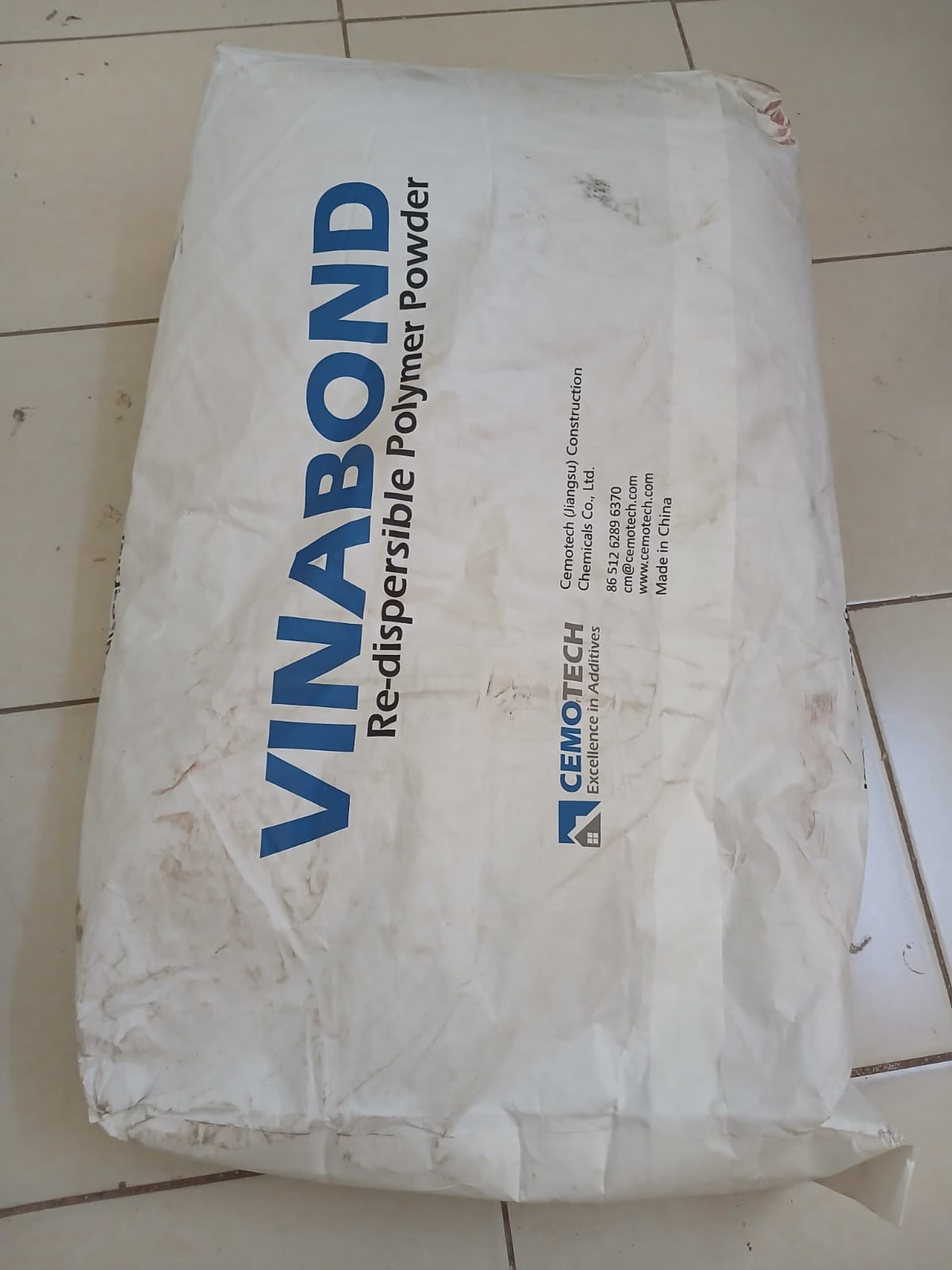
Redispersible Polymer Powder (RDP)
| Product | Redispersible Polymer Powder (RDP) |
|---|---|
| Brand / Manufacturer | Vinabond / Cemotech (Jiangsu) Construction Chemicals Co., Ltd. |
| Appearance | White free-flowing powder |
| Origin | China |
| Main uses | Tile adhesives, wall putty, skim coats, renders, repair mortars |
| Delivery | Same-day in Nairobi; delivery across East Africa |
| Price | Request a quotation |
In stock
Request a quote for this product
Call or message us to confirm stock, pricing and delivery.
- Genuine brands
- Same-day delivery in Nairobi, subject to stock
- Technical advice from our team
Redispersible Polymer Powder for Dry-Mix Mortars
Redispersible Polymer Powder, commonly called RDP, is a key additive in modern dry-mix building products. Manufacturers make it by spray-drying a liquid polymer emulsion into a fine white powder. When you add water on site, the powder redisperses and forms the original emulsion again.
This process matters because it turns a two-part product into a one-bag product. Before RDP, contractors had to mix a liquid latex into cement on site. Now, a manufacturer blends the polymer straight into a bagged tile adhesive or wall putty. As a result, the mason simply adds water and gets consistent quality every time.
Most grades are based on vinyl acetate–ethylene (VAE) copolymer. Other grades use acrylic or styrene-acrylic polymers for specific performance needs. Wisdo Merchants Chemical Division supplies RDP to tile adhesive, wall putty and mortar manufacturers across Kenya from Industrial Area, Nairobi.
Features and Benefits of Redispersible Polymer Powder
- Stronger adhesion: Improves bonding to concrete, plaster, old tiles and other difficult surfaces.
- Greater flexibility: Lets the cured mortar absorb small movements, which reduces cracking and tile debonding.
- Better water resistance: Lowers water absorption in renders, putties and grouts.
- Improved workability: Gives a smoother, creamier mix that spreads easily.
- Higher cohesion and abrasion resistance: Makes the cured layer tougher and less dusty.
- One-component convenience: Removes the need for liquid latex on site.
- Consistent results: Delivers the same polymer content in every bag.
Technical Specifications
| Property | Value |
|---|---|
| Product type | Redispersible polymer powder (RDP) |
| Common base polymer | Vinyl acetate–ethylene (VAE) copolymer |
| Other base polymers | Acrylic, styrene-acrylic (grade dependent) |
| CAS number (VAE copolymer) | 24937-78-8 |
| Appearance | White, free-flowing powder |
| Redispersion | Forms a stable emulsion when mixed with water |
| Typical additives | Protective colloid and mineral anti-caking agent |
| Compatibility | Cement, gypsum and lime-based dry mixes |
Grade-specific values such as solids content, ash content, bulk density and minimum film-forming temperature (MFFT, the lowest temperature at which the polymer forms a continuous film) appear on the product Technical Data Sheet (TDS). A batch COA is available on request.
Applications of Redispersible Polymer Powder
Tile Adhesives and Grouts
Tile adhesive makers use RDP to meet higher bonding and flexibility classes. For example, large-format porcelain tiles on a wall need more flexibility than small ceramic floor tiles, so formulators raise the dosage. It also improves water resistance in flexible grouts.
Wall Putty and Skim Coats
Putty manufacturers add it to make skim coats that stick firmly, sand smoothly and resist cracking. Furthermore, it helps the putty hold paint well without peeling.
Renders, Plasters and EIFS
External renders gain water repellency and flexibility from RDP. Similarly, external insulation and finish systems (EIFS) rely on it to bond insulation boards and base coats.
Repair Mortars and Self-Levelling Compounds
Repair mortars use it to bond strongly to old concrete. Meanwhile, self-levelling floor compounds gain flow, surface strength and crack resistance.
Gypsum Products and Powder Coatings
Gypsum-based joint fillers and plasters also benefit from better adhesion. In addition, some texture coatings and powder paints use it as a binder. Gypsum formulators often pair it with a set retarder such as our crystalline powder acid.
Browse the full range of construction chemicals and adhesives and paints, coatings and pigments.
Typical Dosage Guide
These are common starting ranges by weight of total dry mix. Always confirm with trial batches and the grade’s TDS.
| Application | Typical RDP dosage |
|---|---|
| Standard cement tile adhesive | 1 – 2% |
| Improved or flexible tile adhesive | 2 – 5% |
| Wall putty and skim coat | 1 – 3% |
| EIFS adhesive and base coat | 2 – 4% |
| Repair mortar | 1 – 5% |
| Self-levelling compound | 0.5 – 2% |
RDP usually works alongside a cellulose ether (a water-retaining thickener). The cellulose ether controls open time and sag, while the polymer provides adhesion and flexibility.
Grades and Packaging
Different grades suit different jobs. Some are made for flexibility, others for water resistance or hardness. Therefore, choose the grade that matches your product and performance target.
Contact our sales team to confirm the grades and pack sizes in current stock. We will share the TDS and batch COA before you order.
Safety and Handling
RDP is generally not classed as hazardous. However, it is a fine powder and needs sensible handling.
- Dust: Avoid breathing the dust. Use dust extraction or wear a dust mask when emptying bags.
- Eye contact: Dust may irritate the eyes. Wear safety glasses and rinse with clean water if contact occurs.
- Dust explosion: Like many organic powders, fine dust clouds can ignite. Keep it away from sparks and open flames, and avoid dust build-up.
- Slip hazard: Spilled powder becomes very slippery when wet. Clean spills with a dry method.
Always read the Safety Data Sheet before use.
Storage and Shelf Life
Store bags in a cool, dry place, ideally below 30 °C and away from direct sunlight. Keep bags sealed and off the floor on pallets. Moreover, avoid stacking pallets too high, because heat and pressure can cause the powder to cake. Use it within the shelf life stated on the bag or TDS, and reseal opened bags immediately.
Frequently Asked Questions
What does RDP do in tile adhesive?
It improves bond strength and flexibility. As a result, tiles stay fixed even when the substrate moves slightly or the area gets wet.
Can I use RDP without cellulose ether?
You can, but results are usually poorer. Cellulose ether holds water and prevents sagging, while RDP adds adhesion. Most formulations use both.
Is VAE-based RDP suitable for outdoor use?
Many VAE grades work well outdoors. For high water resistance, choose a hydrophobic grade.
Why has my RDP formed lumps?
It has been exposed to heat, pressure or moisture. Store bags in a cool, dry place and do not stack them too high.
Do you deliver within Nairobi?
Yes. We offer same-day delivery upon order confirmation, subject to stock availability.
Order Redispersible Polymer Powder from Wisdo Merchants
The right polymer turns an ordinary mortar into a premium product that contractors trust. Wisdo Merchants Chemical Division gives you reliable RDP supply and fast delivery from Industrial Area, Nairobi.
Request your quotation today:
- Call or WhatsApp: +254 795 938305
- Email: sales@wisdomerchants.com
- Visit: Dar es Salaam Road, Off Enterprise Road, Industrial Area, Nairobi
- Online: Contact us or browse the full chemical catalogue